 Soku AI
Best D-ID Alternatives for Avatar Video and Ads (2026)
The best D-ID alternatives, grouped by why people leave: presenter realism, UGC-style ads, API pricing, live avatars, or getting the ads launched. What ten 30-second spots cost on each, from prices read 2026-10-20.
D-ID made its name turning a single photo into a talking head, and it has since become three products sharing one minute balance: Studio for avatar videos, Agents for live, two-way avatars, and an API for developers. People rarely leave because the product stopped working. They leave because the job they hired it for has changed shape: their presenter videos need to look more human, their ads need to look like creator content, their developers want usage billing, or they realise the render was never the slow part.
This list is grouped by those reasons. Each group has a first pick and an alternative, and Soku, which publishes this page, appears in one group only. Every price below was read from the vendor's own pricing or help page on 2026-10-20, logged out, in USD. D-ID's full plan table, its API pricing, and the limits that matter for advertisers are on our D-ID review and pricing page; this page doesn't repeat them.
What was and wasn't hands-on. We didn't render a test script in D-ID, HeyGen, Synthesia, Arcads or anyone else, so nothing here grades lip-sync, realism or hook strength from our own footage. The comparisons are built from published prices, plan limits and vendor documentation, and the one cost model below is our arithmetic on those numbers.
The Short Answer
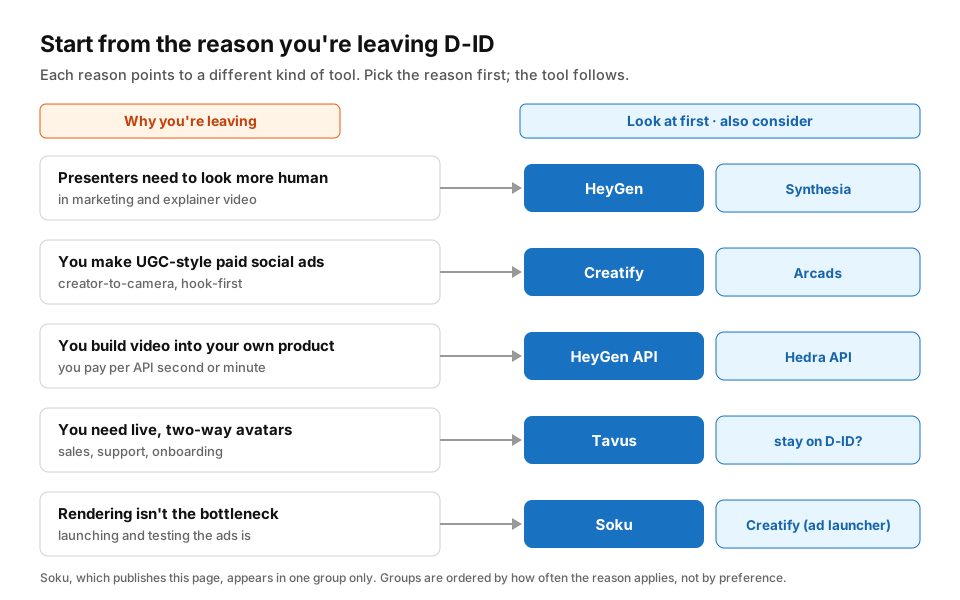
| Why you're leaving D-ID | First pick | Also consider | Entry price (verified 2026-10-20) |
|---|---|---|---|
| Presenters need to look more human | HeyGen | Synthesia | $29/mo (both); HeyGen $24, Synthesia $18 billed annually |
| You make UGC-style paid social ads | Creatify | Arcads | Creatify $15/mo ($12 annually); Arcads unpublished |
| You build video into your own product | HeyGen API | Hedra API | Pay as you go, no subscription |
| You need live, two-way avatars | Tavus | Stay on D-ID | Tavus $22/mo for 60 conversation minutes |
| Rendering isn't the bottleneck; launching and testing is | Soku | Creatify's ad launcher | Soku video generation from $19/mo |
The Original Bit: Ten 30-Second Spots, Priced Everywhere
The planning question behind most "D-ID alternative" searches from advertisers is: if I produce the same batch of ad scripts somewhere else, what will it cost me? We couldn't render that batch in every tool, so we priced it instead. The job is ten 30-second avatar spots, which is 5 finished minutes, a realistic first hook test. For each tool we picked the cheapest tier on monthly billing whose allowance covers those 5 minutes, using only the vendor's own published rates.
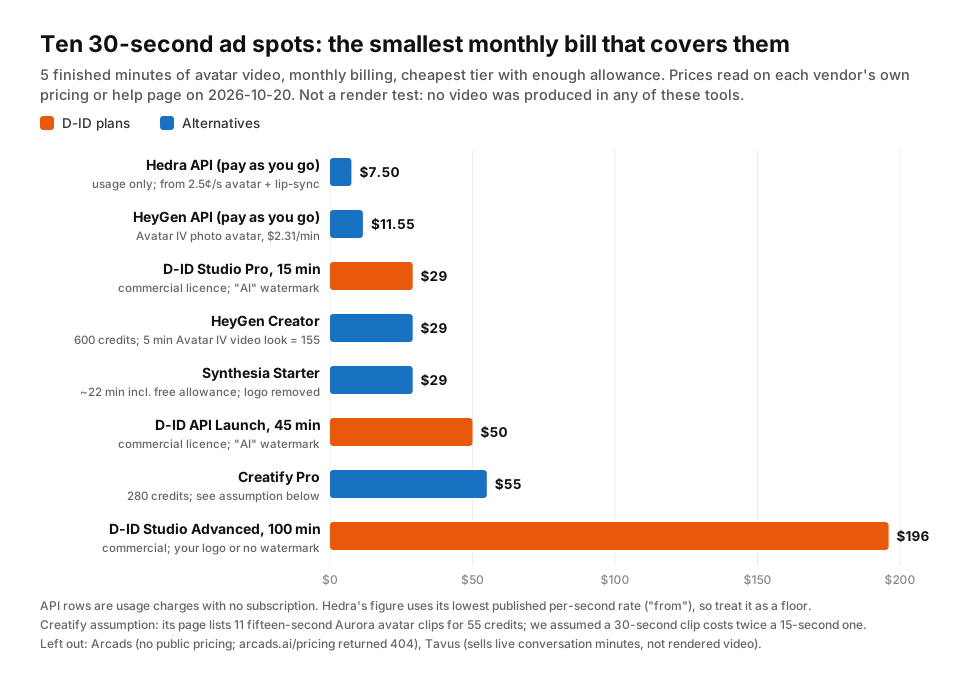
How each number was worked out:
| Tool and tier | Monthly price | What covers the 5 minutes | Branding on output |
|---|---|---|---|
| D-ID Studio Pro (15-minute tier) | $29 | 15 minutes a month | "AI" watermark |
| D-ID Studio Advanced (100-minute tier) | $196 | 100 minutes a month | Your logo, or none |
| D-ID API Launch (180 credits) | $50 | Up to 45 minutes of video | "AI" watermark |
| HeyGen Creator | $29 | 600 credits; Avatar IV video look is 31 credits/min, so 5 min = 155 credits | Watermark removed |
| Synthesia Starter | $29 | 10 free minutes plus up to ~12 from credits | Synthesia logo removed |
| Creatify Pro | $55 | 280 credits; Standard's 55 credits cover 11 fifteen-second avatar clips | Watermark removed |
| HeyGen API | $11.55 usage | Avatar IV photo avatar at $2.31/min | n/a (API) |
| Hedra API | $7.50 usage | Avatar and lip-sync from 2.5¢ per second | n/a (API) |
What this shows:
- The $29 tier is crowded, but it doesn't buy the same thing. D-ID Pro, HeyGen Creator and Synthesia Starter all cost $29 a month billed monthly. Only D-ID's version still stamps an "AI" watermark on the video. For an ad that's a creative decision you can live with or not, but it's worth knowing before you compare quality.
- On D-ID, clean output is a $167 jump. Studio Advanced is the first Studio plan where the watermark becomes your own logo or nothing. That is the one D-ID number that most often sends advertisers looking elsewhere.
- Usage billing wins for small batches. If you only need a batch now and then, the per-minute APIs cost a fraction of a subscription. The trade-off is that you need someone who can call an API.
- Assumptions we had to make. Creatify publishes credits per 15-second clip, not per 30-second one; we assumed a 30-second clip costs twice as much, which pushes the job off Standard ($15) and onto Pro. Hedra's figure is its lowest "from" rate, so treat it as a floor. Arcads is left out because it publishes no pricing, and Tavus because it sells live conversation minutes, not rendered video.
1. Presenters That Look More Human
Best for: marketers and enablement teams making spokesperson, explainer and product videos, for whom the avatar's realism is the product.
HeyGen: when you want more presenter for the same $29
Price (heygen.com/pricing and HeyGen's credits help article, 2026-10-20): Free ($0, 3 videos a month up to 1 minute each). Creator $29 a month, or $24 billed annually, with 600 credits, 1080p export, watermark removal, unlimited photo avatars, voice cloning and credit rollover. Pro from $49 with 1,000 credits and 4K export, scaling up to 100,000 credits at $4,300. Business $149 with 1,500 credits, plus $20 per extra seat. Credits are spent per minute and depend on the model: Avatar III costs 4 to 7 credits a minute, Avatar IV 16 (photo look) or 31 (video look), and Avatar V 48.
Why it fits D-ID leavers: at the same $29 entry price, HeyGen removes its watermark, and its credit meter lets you choose between cheap Avatar III minutes and more realistic Avatar IV or V minutes for each video. Creator's 600 credits are about 19 minutes of Avatar IV video look, or 150 minutes of Avatar III video look.
Pick it if: realism and voice cloning matter more than live agents.
Skip it if: you mainly need real-time conversational avatars, where D-ID is more focused. HeyGen's own pricing, limits and alternatives are covered on our HeyGen alternatives page.
Synthesia: when the video is training, not an ad
Price (synthesia.io/pricing, 2026-10-20): Basic is free with 10 minutes of video a month, but videos carry a Synthesia watermark and can only be shared by link. Starter is $29 a month, or $18 billed annually, and adds downloads, logo removal and enough credits for up to about 12 more minutes a month. Pro is $89 a month ($64 annually), with up to about 60 extra minutes and 5 personal avatars. Enterprise has unlimited video minutes on custom pricing.
Why it fits: Synthesia is the closest like-for-like to D-ID Studio for structured business video: templates, 125+ avatars on Starter and 180+ on Pro, branded video pages, interactive video and surveys. For an annual buyer, Starter at $18 a month is the cheapest clean-output presenter plan on this page.
Pick it if: your videos are onboarding, training or internal comms.
Skip it if: you want creator-style ads; Synthesia's library and templates lean corporate. See our Synthesia alternatives page, and HeyGen vs Synthesia for how the two meter usage differently.
2. UGC-Style Paid Social Ads
Best for: performance marketers who need many short, creator-to-camera ad variants rather than one polished presenter video.
D-ID's avatars come from stock and personal avatars in a studio editor. Ad-first tools start from the ad instead: a product link or script goes in, and a vertical, hook-first video with an AI actor comes out.
Creatify: when you want ad formats, not a video editor
Price (creatify.ai/pricing, 2026-10-20): Standard $15 a month, or $12 billed annually (the page offers 20% off annual), with 55 credits. Pro $55 ($44 annually) with 280 credits. Max $95 ($76 annually) with 730 credits, 3 seats and 3 brand spaces. The free plan has 10 credits a month and watermarked exports. Credits stay valid for two months. Creatify's own examples for Standard's 55 credits: 11 fifteen-second Aurora avatar videos, or 220 images.
Why it fits: the library is AI actors, not presenters: 300 on Standard and 1,500 on Pro, plus 3 custom avatars from Pro up. The comparison table lists ad templates, ad cloning and an ad launcher for Meta, TikTok and AppLovin. That's the workflow a D-ID advertiser is otherwise stitching together by hand.
Pick it if: most of your output is 15 to 30 second social ads.
Skip it if: you need videos longer than 2 minutes on Standard or 10 minutes on Pro, which are its caps.
Arcads: same job, but pricing behind a sign-up
Arcads is the best-known name for AI-actor UGC ads, and the obvious comparison for this group. We can't give you its price: on 2026-10-20, arcads.ai/pricing, arcads.ai/plans and app.arcads.ai/pricing all returned HTTP 404, and the price is shown only after you create an account. Our Arcads alternatives page covers what it does and why the missing price matters to a team that has to approve a budget line.
3. Building on an API
Best for: product teams putting avatar video inside their own app, and growth teams scripting batch renders.
D-ID's API plans are subscriptions: Build at $18 a month for 16 minutes, Launch from $50, Scale from $198. You pay every month whether you render or not, and unused minutes expire. The two alternatives below bill only for what you generate. (D-ID's API tiers in full are in the review.)
HeyGen API: pay as you go, per second
Price (HeyGen's "API Pricing Explained" help article, 2026-10-20): API credits are bought in dollars with no plan or subscription, and are separate from HeyGen app credits. Rates are per minute, charged by actual seconds generated: Avatar III from $0.60 a minute (digital twin) or $0.99 (photo or studio avatar), Avatar IV $2.31 (photo avatar) or $4.83 (digital twin or studio avatar), Avatar V digital twin $7.20. Lip-synced translation is $0.81 a minute in Speed mode.
Why it fits: no monthly minimum, per-second billing instead of 15-second rounding, and a choice of engines per call. Five minutes of Avatar IV photo-avatar video costs $11.55.
Hedra API: per second, with no subscription
Price (hedra.com/pricing, 2026-10-20): a prepaid dollar balance with "no subscription, no seats, no minimum." Avatar and lip-sync start at 2.5¢ a second ($1.50 a minute), video generation at 1.13¢ a second, and voice cloning is free. These are "from" rates; Hedra lists the full rate for each model in its catalog.
Why it fits: Hedra covers D-ID's original party trick, a still portrait made to speak, with usage billing, and also offers general video, image and audio models from the same balance.
Pick this group if: an engineer owns the integration and volume is uneven month to month.
Skip it if: non-technical marketers need to make videos in an editor.
4. Live, Two-Way Avatars
Best for: sales, support and onboarding teams that want an avatar that listens and answers in real time.
This is where D-ID is most focused, so be honest with yourself about why you're leaving. D-ID's V4 model is built for real-time agents. D-ID's tech-spec page claims under 500 ms end-to-end conversational latency and up to 4K output. It also publishes a SyncNet lip-sync benchmark from June 2026 that ranks D-ID first, ahead of Anam, HeyGen and Tavus. That benchmark was designed and run by D-ID, so weigh it accordingly.
Tavus: when conversation minutes are the unit you buy
Price (tavus.io/pricing, 2026-10-20): Free with 20 minutes of conversational video. Starter $22 a month for 60 minutes, 1 custom face and 1 concurrent session, with no overage. Builder $59 for 175 minutes, 3 concurrent sessions and pay-as-you-go overage. Growth $397 for 1,300 minutes and 10 concurrent sessions. Business $975 for 4,000 minutes. Paid plans have no watermark, and Tavus supports Google Meet and Zoom configurations.
Why it fits: Tavus sells conversation minutes and concurrency directly. On D-ID's API plans, streaming minutes come bundled with video minutes: Launch's entry tier includes up to 90 streaming minutes for $50.
Pick it if: your avatar mostly talks to people live, including inside video calls.
Stay on D-ID if: you want rendered videos and live agents from one minute balance and one avatar.
5. When Rendering Isn't the Bottleneck
Best for: small teams whose avatar videos are fine, but who spend more time getting variants into ad accounts and reading the results than making them.
Soku
What it is: Soku, which publishes this page, is an AI marketing agent, not an avatar studio. Be clear about what that means before you consider it here.
What it can do with avatar-style video:
- The AI avatar video generator animates one uploaded portrait into a clip of 4 to 15 seconds at 480p or 720p, in 9:16, 16:9, 1:1 or other ratios, with optional generated audio. It runs on Seedance 2.0 Mini, a generative video model.
- The AI lip sync tool re-times the face in your own clip (up to 15 seconds) to an audio track you supply, using Sync Lipsync 2.
- Voiceover comes from ElevenLabs v3 text-to-speech.
- The agent can create, change or copy campaigns on Google, Meta and TikTok, and asks you to confirm the change first.
What it doesn't have, compared with D-ID: no stock presenter library, no script-to-presenter editor, no videos longer than 15 seconds from one generation, and no real-time agents. It's also not cheap per minute of avatar video. At the rates in the tool's code, a 15-second 720p clip costs 2,505 credits, so the Creator plan's 7,000 monthly credits cover two of them. If you need minutes of presenter video, a dedicated tool above is much cheaper.
Price (soku.ai/pricing, 2026-10-20): a free plan for chat and agent work. Video generation requires Creator, at $19 a month or $180 a year, with 7,000 credits a month. Starter is $49 a month and Pro $249.
Pick it if: you already have your hooks, and the gap is turning "variant B won on Meta" into the next round of changes in the ad account.
Skip it if: what you're replacing is D-ID's presenter videos themselves.
Creatify's ad launcher
Creatify, from group 2, lists an Ad Launcher and an AI Performance Agent for Meta, TikTok and AppLovin on its plan comparison. If your ads are UGC-style and you want one tool for both making and launching them, check which Creatify tier includes those before you buy.
When to Stay on D-ID
Stay if most of these are true:
- You run live agents and rendered videos from the same avatar. D-ID's Studio minutes cover videos, agents, translation and API from one balance, so one plan and one avatar do both jobs.
- Your videos are personal or internal. Lite at $5.90 a month for 10 minutes ($4.70 billed annually) is hard to beat if a D-ID watermark and a personal-use licence are acceptable.
- You work in Canva or PowerPoint. D-ID's pricing page lists a Canva app and a PowerPoint add-in on its plans.
- You trust its lip-sync claims for real-time use and have checked them against your own avatar and script, which is the only test that counts.
Related Reading
- D-ID review and pricing: every Studio and API plan, cost per minute, the watermark ladder and the 15-second rounding rule.
- HeyGen alternatives: where HeyGen's credit pricing gets expensive and what to use instead.
- Synthesia alternatives: training video vs ad creative.
- HeyGen vs Synthesia: the two biggest presenter tools, metered side by side.
- Arcads alternatives: UGC actor ads and the pricing you can't see.
Frequently Asked Questions
What is the best alternative to D-ID?
It depends on why you're leaving. For marketing and explainer video with a more natural presenter, HeyGen is the first one to try: Creator is $29 a month with 600 credits and watermark removal, and its Avatar IV model costs 16 to 31 credits per minute. Synthesia is the like-for-like for training and corporate video. For UGC-style paid social ads, look at Creatify. For developers, HeyGen's pay-as-you-go API and Hedra's per-second API remove the monthly commitment. For live, two-way avatars, Tavus is the main specialist. All prices read on each vendor's own pages on 2026-10-20.
Is there a cheaper alternative to D-ID?
For personal projects, D-ID's own Lite plan is already among the cheapest at $5.90 a month for 10 minutes ($4.70 billed annually), but it carries a D-ID watermark and a personal-use licence. For commercial ads, the cheapest D-ID route is Studio Pro at $29 a month, which still adds an "AI" watermark; removing it takes Studio Advanced at $196 a month. HeyGen Creator and Synthesia Starter are also $29 a month and both remove their own branding at that price. If you only need occasional renders, usage-billed APIs such as HeyGen's ($2.31 per minute for an Avatar IV photo avatar) avoid a subscription entirely.
Which D-ID alternative is best for video ads?
For UGC-style ads where an actor talks to camera, Creatify is built for that format: it has a library of AI actors, ad templates and, on its plan comparison, an ad launcher for Meta, TikTok and AppLovin. Arcads targets the same job, but it publishes no pricing; arcads.ai/pricing returned 404 on 2026-10-20. For more polished spokesperson ads, HeyGen is the stronger presenter tool. None of these were tested hands-on for this page; we compared published prices and documented features.
Did you render the same ad in D-ID, HeyGen, Synthesia and Arcads?
No. We didn't buy seats in these tools or render a test script, so this page makes no claim about which one has better lip-sync or a better hook. What we did was read each vendor's pricing and help pages on 2026-10-20 and work out what the same job, ten 30-second ad spots, would cost on each. D-ID publishes its own lip-sync benchmark ranking itself ahead of HeyGen and Tavus for real-time avatars; that is a vendor-run test, and we report it as such.
Is HeyGen better than D-ID?
For marketing video, HeyGen offers more on its $29 entry plan: watermark removal, 1080p export, unlimited photo avatars and voice cloning, against D-ID Pro at $29 with an "AI" watermark and one voice clone. D-ID is stronger for real-time conversational agents, where its V4 model is built around sub-500 ms response, and its entry plans are cheaper for personal use. Our HeyGen alternatives page and HeyGen vs Synthesia comparison cover HeyGen's own limits.
Is there a free D-ID alternative?
Several tools have free tiers, with limits. HeyGen Free allows 3 videos a month up to 1 minute each; watermark removal starts on Creator. Synthesia Basic includes 10 minutes of video a month, but you can only share by link, not download. Creatify's free plan gives 10 credits a month with watermarked exports. Tavus Free includes 20 minutes of conversational video. D-ID itself has a 14-day trial with 3 minutes and a full-screen watermark, not a permanent free plan.
Is Soku a D-ID replacement?
Only for one reason to leave. Soku has no stock presenter library and no script-to-presenter editor like D-ID's Studio. Its avatar video tool animates one uploaded portrait into a 4 to 15 second clip at up to 720p, and a separate lip-sync tool re-times a face in your own clip to an audio track. Video generation requires the Creator plan ($19 a month). What Soku adds is the step after the render: it is an AI marketing agent that can create and change campaigns on Google, Meta and TikTok after you confirm. If you need long presenter videos, use a dedicated avatar tool.