
 Soku AI
Northbeam vs Triple Whale (2026): Pricing by GMV Band, Attribution Models and Which Fits Your Brand
Northbeam vs Triple Whale from both vendors' own pages, verified 2026-10-20. Triple Whale prices by annual GMV ($219 to $4,199 a month across nine published bands). Northbeam prices by ad spend and pageviews ($1,500 Starter, $3,500/mo Professional). The fit by GMV band, and how their two 'Clicks + Deterministic Views' models split the same order differently.
Prices and feature claims last verified against both vendors' own published pages on 2026-10-20.
Northbeam and Triple Whale both sell first-party multi-touch attribution to ecommerce brands. Both run their own pixel, both now offer a "Clicks + Deterministic Views" model, and both sell MMM and incrementality testing on top. Most head-to-heads stop at that overlap and call it a tie on features.
The differences that change your decision are further down: what each one meters to set your price, at what brand size each one publishes a number, and how their similarly named models actually split credit. This page compares those three things using only what each vendor publishes about itself, read on 2026-10-20. We have not run both tools on the same store, and we will not imply a measured accuracy difference. Neither vendor publishes a method that would let anyone test that from outside.
Neither product is ours. We build AI advertising software, and a short note on where it sits is at the end, after the comparison.
The Short Answer
- Triple Whale fits Shopify-centric brands from roughly $250K to $20M in annual GMV that want attribution, BI and an AI agent in one subscription. It also suits brands that want the agent to make ad changes inside guardrails. It publishes a price for every band in that range.
- Northbeam fits brands where paid media is the main growth lever and spend is meaningful: its own plan copy talks in ad spend, from under $1.5M a year up to more than $500K a month. It sells measurement plus human media strategy rather than an execution agent. Below Starter, it does not publish a number.
- Under about $1M GMV, Triple Whale Foundation's published prices are about 15–29% of Northbeam's lowest published figure. The gap closes as you grow. At Triple Whale's top published band, Northbeam Professional's list price is below Triple Whale Automate.
The One Difference That Explains The Bill
The two vendors meter different things.
Triple Whale meters your revenue. Its pricing FAQ states: "All prices are based on a combination of your brand's annual GMV and the package you choose: Foundation, Automate, or Enterprise." Every paid plan includes unlimited users and stores.
Northbeam meters your ad spend and your traffic. The pricing page header reads "Based on your annual marketing spend, choose the option that's best for you", and each plan is described by a spend ceiling. The FAQ then adds a second meter: "your monthly price is informed by the volume of data in your business (measured in pageviews)." That is why the cards say "Contact us for a quote" even where a number is printed.
Revenue, ad spend and pageviews move together, but not in a fixed ratio. A brand with high AOV and low traffic pays relatively little on Northbeam's meter. On Triple Whale's GMV meter, the same brand pays the same as any other brand of its size. A brand with heavy organic demand and light paid media looks small to Northbeam's plan copy and large to Triple Whale's. Work out which of the two meters your business is lean on before you compare any prices.
The Verified Price Tables
Triple Whale, verified 2026-10-20
Triple Whale's pricing page still renders no prices on screen. The GMV slider described in its own FAQ is switched off by a SHOW_SLIDER flag set to false in the page code. The full price table ships to every visitor's browser in that same code. We read it on 2026-10-20, and it is unchanged from the ladder in our Triple Whale pricing breakdown (verified 2026-09-10).
| Annual GMV band | Foundation /mo | Automate /mo | Retention add-on | Conversion add-on |
|---|---|---|---|---|
| Under $250K | $219 | $749 | $79 | $19 |
| $250K–$500K | $329 | $899 | $99 | $29 |
| $500K–$1M | $429 | $1,099 | $129 | $49 |
| $1M–$2.5M | $549 | $1,349 | $179 | $59 |
| $2.5M–$5M | $799 | $1,799 | $249 | $79 |
| $5M–$7.5M | $1,129 | $2,399 | $349 | $99 |
| $7.5M–$10M | $1,529 | $2,899 | $479 | $139 |
| $10M–$15M | $1,849 | $3,499 | $579 | $159 |
| $15M–$20M | $2,529 | $4,199 | $749 | $219 |
| $20M and above (13 further bands) | No price | No price | No price | No price |
Free is $0 with 10 users. Enterprise is custom at every band. The comparison table's sticky header shows Foundation at $549 and Automate at $1,349, which is the $1M–$2.5M row. Per the FAQ, all three paid plans are 12-month subscriptions whether you pay monthly or annually. Annual prepay is "2 months free", and the page code computes it as exactly 10× the monthly price. Prepaying also locks your GMV tier for the year.
Northbeam, verified 2026-10-20
| Plan | Published price | Who it is for (Northbeam's words) | Notable inclusions |
|---|---|---|---|
| Growth | Custom ("See if you qualify") | "Seven-figure brands spending under $200K/month on ads that want Northbeam attribution with hands-on agency support" | Full MTA, dashboards and Northbeam MCP; creative, strategy and media buying from a preferred Northbeam agency partner; up to $50,000 in partner ad credits |
| Starter | $1,500, no billing period printed | Brands "spending less $1.5m a year on ads" | First-party MTA, omnichannel dashboards, Northbeam Apex, C+DV view-through attribution, Northbeam MCP; up to $100,000 in ad credits |
| Professional | $3,500 / per month | "Growth marketers spending up to $500k a month on ads" | Unlimited users, data exports and integrations; any ecommerce platform, not just Shopify; dedicated Media Strategist; more data refresh options; Incrementality optional; up to $150,000 in ad credits |
| Enterprise | Custom | "Sophisticated teams spending more than $500k a month on ads" | Media-buying guidance, dedicated CSM and Slack channel, optional hourly conversion data, touchpoint-level export, geo dashboards, custom ecommerce builds; MMM+ and Incrementality optional; up to $200,000 in ad credits |
Contract terms, from Northbeam's FAQ: Starter is "month-to-month usage-based pricing for Shopify brands that are in the early growth stage." Professional and Enterprise are annual terms with annual or semi-annual billing.
Three things on Northbeam's page do not line up, and you should settle each one in writing:
- The Starter card prints "$1,500 / for maximum value" with no period. The FAQ calls Starter month-to-month, so a monthly reading is the natural one, but the card does not say so. Every comparison below that treats it as monthly is labelled.
- The Enterprise threshold differs. The Enterprise card says more than $500K a month in ad spend. The FAQ answer to "Which plan should I choose?" says "If you are spending more than $250,000 a month on performance marketing, we recommend Enterprise."
- The FAQ refers to "Growth and Professional" as the plans below Enterprise and does not mention Starter.
Fit By GMV Band
This is where the two price lists meet. Triple Whale publishes by GMV, Northbeam by ad spend. Getting from one to the other needs an assumption about how much of your revenue you spend on ads. Neither vendor publishes that. The ratio below is ours, used only to place Northbeam's ad-spend lines on a GMV axis. Change it to your own.
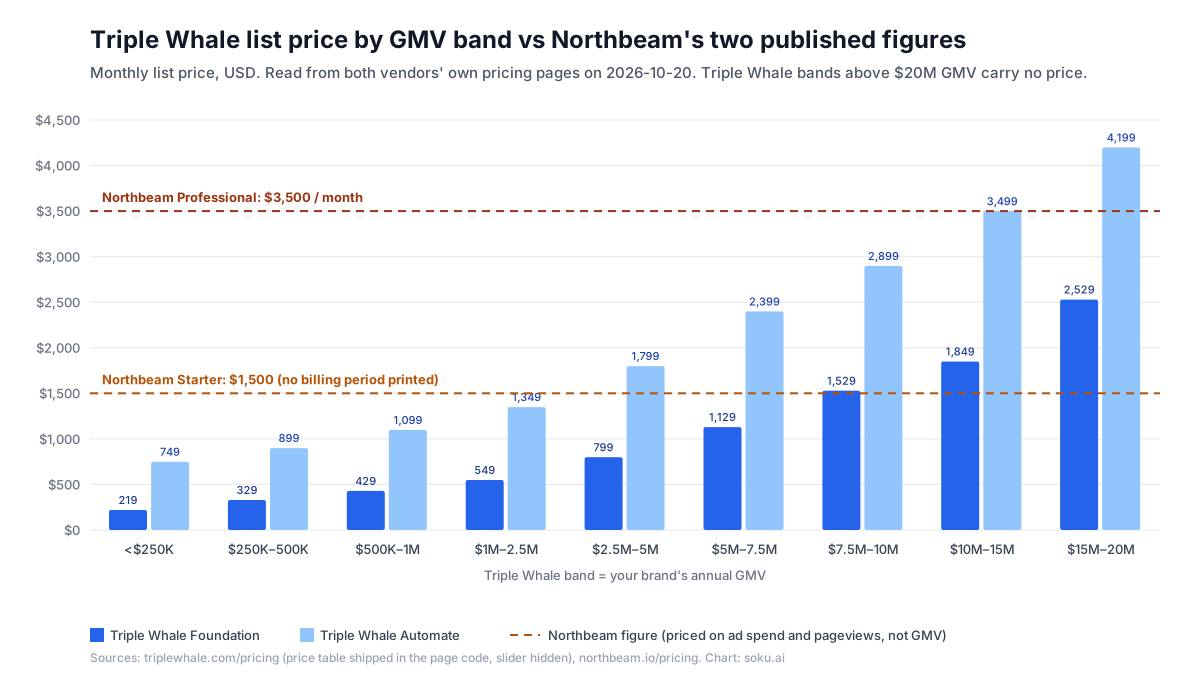
First, where Northbeam's own ad-spend lines fall in GMV terms at three ad-spend-to-GMV ratios. This is our arithmetic on Northbeam's published thresholds:
| Northbeam threshold (its words) | Annual ad spend | GMV at 10% ad spend | GMV at 20% | GMV at 30% |
|---|---|---|---|---|
| Starter: under $1.5M a year | $1.5M | $15M | $7.5M | $5M |
| Growth: under $200K a month | $2.4M | $24M | $12M | $8M |
| Professional: up to $500K a month | $6M | $60M | $30M | $20M |
| FAQ's Enterprise recommendation: over $250K a month | $3M | $30M | $15M | $10M |
Now the full matrix, using 20% ad spend as an illustration:
| Triple Whale GMV band | TW Foundation /mo | TW Automate /mo | Ad spend at 20% (mid-band) | Northbeam plan by its own copy | Northbeam published figure |
|---|---|---|---|---|---|
| Under $250K | $219 | $749 | ~$25K/yr | Starter | $1,500 (not stated as monthly) |
| $250K–$500K | $329 | $899 | ~$75K/yr | Starter | $1,500 |
| $500K–$1M | $429 | $1,099 | ~$150K/yr | Starter | $1,500 |
| $1M–$2.5M | $549 | $1,349 | ~$350K/yr | Starter | $1,500 |
| $2.5M–$5M | $799 | $1,799 | ~$750K/yr | Starter | $1,500 |
| $5M–$7.5M | $1,129 | $2,399 | ~$1.25M/yr | Starter | $1,500 |
| $7.5M–$10M | $1,529 | $2,899 | ~$1.75M/yr | Professional (or Growth via agency) | $3,500/mo (Growth: custom) |
| $10M–$15M | $1,849 | $3,499 | ~$2.5M/yr | Professional (or Growth via agency) | $3,500/mo (Growth: custom) |
| $15M–$20M | $2,529 | $4,199 | ~$3.5M/yr | Professional per the card; Enterprise per the FAQ | $3,500/mo, or custom |
| $20M+ | Not published | Not published | — | Professional or Enterprise | $3,500/mo, or custom |
What the matrix shows, treating Northbeam's Starter figure as monthly:
- Under $1M GMV: Triple Whale Foundation is $219–$429 against $1,500 for Northbeam Starter, which is 3.5× to 6.8× cheaper. Even Automate, at $749–$1,099, sits below Northbeam's lowest published figure.
- $1M–$5M GMV: the gap narrows. Foundation at $549–$799 is 1.9× to 2.7× cheaper than Starter, and Automate ($1,349–$1,799) is close to it.
- $5M–$10M GMV: Foundation at $1,129–$1,529 is roughly level with Starter. Once Northbeam's ad-spend line pushes you to Professional, it is $3,500 against $2,399–$2,899 for Automate.
- $15M–$20M GMV: Northbeam Professional at $3,500 is $699 a month below Triple Whale Automate at $4,199, and $971 above Foundation at $2,529. This is the only published band where Northbeam's list price beats Triple Whale's AI tier.
- Above $20M GMV: Triple Whale publishes nothing. Northbeam publishes Professional at $3,500 a month up to its $500K-a-month spend ceiling. At that size you are negotiating with both.
Northbeam's FAQ says plans "start at" these rates and scale with pageviews, so the Northbeam column is a floor, not a quote. Triple Whale's numbers are its list prices, but they are not shown on screen. Treat both as the place a negotiation starts.
The Attribution Models, Side By Side
Both vendors say they offer roughly the same set of models. Here is what each one documents, as read on 2026-10-20.
| Northbeam | Triple Whale | |
|---|---|---|
| Single-touch models | First Touch, Last Touch, Last Non-Direct Touch | First Click, Last Click |
| Rule-based multi-touch | Linear; Clicks-Only (default), which splits credit equally but strips Direct, Organic Search, Branded Search, Email and SMS | Linear All, Linear Paid; Triple Attribution, which gives each platform 100% credit for its own last click |
| Modelled views | Clicks + Modeled Views: machine learning on impression and engagement data; 1-day view window only; 25–30 days to learn | Triple Attribution + Platform Views: adds platform-reported view-through where supported |
| Verified views | Clicks + Deterministic Views (C+DV) | Clicks & Deterministic Views (C&DV) |
| Survey-weighted | Not offered | Total Impact: weights channels by post-purchase survey answers; needs 7+ days of survey data and behaves like Linear All without it |
| Attribution windows | 1, 3, 7, 14, 30, 90-day click and LTV; C+MV uses click windows plus a 1-day view | 1, 7, 14, 28-day and Lifetime; help centre states the default is 28 days |
| Lookback (eligibility) | Separate setting: 90 days, 180 days (default), 1 year or 10 years; changing it restates history | Not documented as a separate setting in the articles we read |
| When credit lands | Two accounting modes. Accrual Performance credits the day of the touchpoint (the default on Overview and Sales). Cash Snapshot credits the day of the order. Windows only work in Accrual | No equivalent named setting in the articles we read |
| On the free tier | No free tier | Free plan: First and Last Click only, Lifetime window only |
Two of these rows matter more than the rest.
Northbeam's accounting modes are a real difference. Accrual Performance puts revenue on the day the ad touched the customer, which is what a media buyer needs to judge yesterday's spend. Cash Snapshot puts it on the day the money arrived, which is what finance needs to reconcile with Shopify. Northbeam's own docs describe MER as the Cash Snapshot metric and ROAS as the Accrual metric. If finance and media buying argue about which number is right, a tool that names the two views and lets you switch between them is worth more than another model.
Triple Attribution should not be summed. Triple Whale's own help centre warns that because each platform gets 100% credit, total attributed revenue across channels will exceed actual revenue, and that the model should not be used for financial reporting. That is fine for in-platform optimisation, but if your team adds up the All Channels view, the total is wrong by design.
Same Name, Different Rules: The Two C+DV Models
This is the comparison most coverage of these two tools misses. Both vendors now sell a "Clicks + Deterministic Views" model. Both define deterministic the same way: a view counts only when the ad platform verifies it and it can be joined to a real order, rather than inferred. Below that shared definition, the documented credit rules diverge.
| Northbeam C+DV | Triple Whale C&DV | |
|---|---|---|
| Participating view platforms | Meta, TikTok, Snap, Pinterest, Axon, Vibe, MNTN (launch post) | Meta, TikTok, Pinterest, Vibe, AppLovin, Snapchat (help centre, updated late Sept 2026) |
| Time decay | None documented; "credit is not assigned based on where each touchpoint falls in the funnel" | Yes: click weight halves every 7 days, view weight halves every 1 day |
| How views are grouped | Per-platform "pools"; views from different platforms are not weighted differently | Clicks plus "the most recent ad view (when no click occurred)" are eligible |
| Lower-funnel touchpoints | Direct, Organic, Organic Search, Branded Search, Email and SMS get nothing when paid clicks or verified views exist | Owned and demand-capture channels "may receive reduced or no credit" when preceded by higher-funnel touches |
| Click and view de-duplication | View and click pairs within 30 seconds are de-duplicated | Normalised so each order is counted once |
| View data refresh | 3× per day | Once daily; up to 48 hours to start after enabling |
| Stated requirement | Meta needs ≥80% order-ID match between Meta Purchase events and Northbeam orders | Supported ad platforms connected; 24–48 hours to populate |
To see how far apart those rules land, take one journey. A customer clicks a Meta ad 7 days before buying, sees a Snap ad 3 days before, sees a TikTok ad 1 day before, then clicks a branded search ad and places a $100 order.
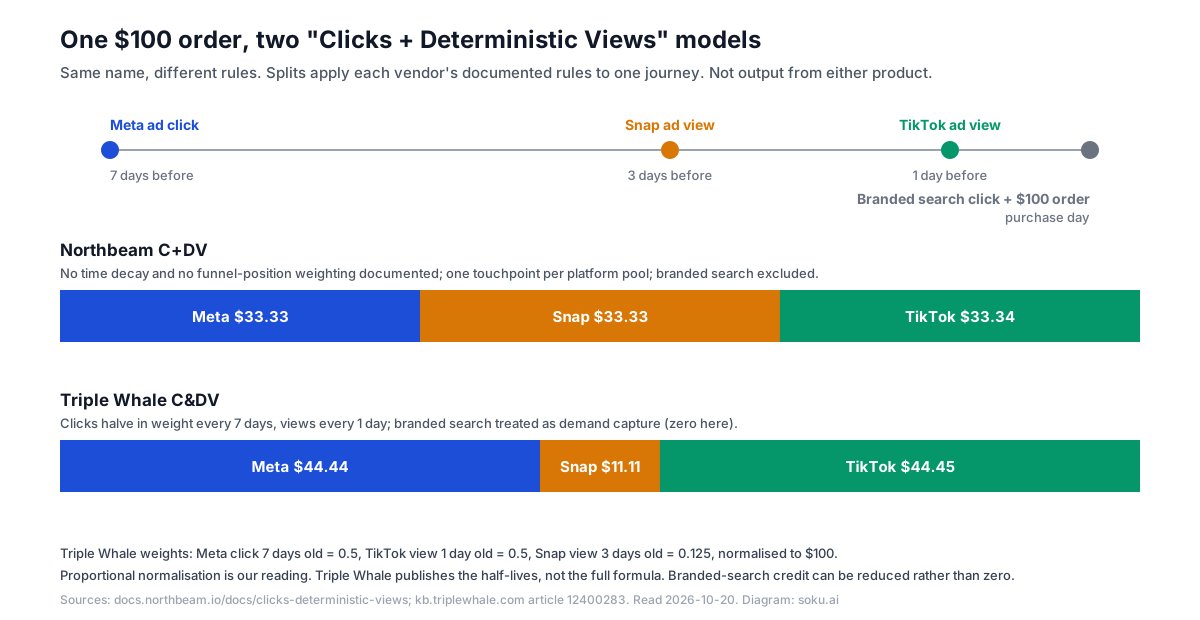
- Northbeam's rules: branded search is excluded because paid touchpoints exist. That leaves three platforms with one touchpoint each. Northbeam documents no time decay and no weighting by platform or funnel position, and in its own worked example a click and a view in the same platform pool earned the same amount. So the three split evenly, at about $33 each.
- Triple Whale's rules: a 7-day-old click has weight 0.5, a 1-day-old view 0.5, and a 3-day-old view 0.125. Normalised to $100, that gives Meta ~$44, TikTok ~$44, Snap ~$11. Triple Whale publishes the half-lives but not the full normalisation formula, so proportional normalisation is our reading. Its "most recent ad view" wording could also be read to drop the Snap view entirely, giving a 50/50 split.
Neither split is more correct, because the two models answer different questions. Triple Whale's rewards recency, so views shown close to purchase carry most of the credit. Northbeam's ignores timing, so a view a week ago counts as much as one yesterday. If your prospecting runs on view-heavy placements with long consideration windows, the two tools will report different winners from the same spend. Decide which assumption you believe before you pick the tool, not after.
One more gap is worth knowing. Northbeam's own docs contain a view-only example (1 Snap view, 2 Meta views, 3 TikTok views) where the prose says each platform "starts with an equal share", but the table credits 21%, 35% and 44%. The table implies a platform's pool grows with its view count, less than proportionally. If view counts per platform vary a lot in your journeys, ask Northbeam which of the two descriptions the product follows.
MMM, Incrementality And The AI Layer
| Northbeam | Triple Whale | |
|---|---|---|
| MMM | MMM+, optional on Enterprise only. Product page: daily forecasts and budget adjustments, can ingest Northbeam MTA data; Northbeam's MMM guide says it retrains weekly | Inside Compass: included on Enterprise, add-on on Foundation and Automate. Needs ~24 months of history (36 recommended); refreshes weekly; recommended for ~$10M+ GMV |
| Incrementality | Optional on Professional and Enterprise; automated test design, pacing and validation in-product | Inside Compass: holdout and GeoLift tests, reported with a Probability of Direction and a result range |
| Combining the signals | Positions MTA, MMM and incrementality as one platform on the same first-party data | Compass scores confidence per channel and flags where MMM and incrementality disagree |
| AI and agents | Northbeam MCP from Growth and Starter up; no in-platform execution agent listed on the pricing page | Moby: analyst on every plan; on Automate, scheduled Automations, Actions (adjust budgets, pause ads, launch campaigns within approval settings), Creative Studio and Moby Landing Pages. AI usage is a separate allowance, sized by plan and GMV |
| Human help | Dedicated Media Strategist (Professional), media-buying guidance and CSM (Enterprise), agency partner (Growth) | Dedicated CSM and implementation specialist for "qualifying accounts", defined as $10M+ GMV; live chat otherwise |
| Signal back to ad platforms | Apex: sends Northbeam's first-party conversion data to ad delivery algorithms (Starter and up) | Sonar Send and Sonar Optimize: included on every new paid package |
The pattern is consistent. Triple Whale is building software that acts. Northbeam sells measurement plus people. If you have a media buyer or agency and want better numbers to hand them, Northbeam's shape fits. If you are a small team that wants the tool to take the next step itself, Triple Whale's Automate tier is built for that. It is also the tier where its price rises fastest relative to Foundation (3.4× at the smallest band).
Which One To Choose
Choose Triple Whale if:
- You are under about $5M in GMV and want multi-touch attribution for a few hundred dollars a month. No Northbeam plan publishes a number in that range.
- You run Shopify, run several paid channels, and want BI, attribution, survey-weighted attribution and an AI agent in one contract.
- You want software, not a strategist, to pause ads and shift budgets within guardrails, and you can justify Automate's step up.
- You value unlimited seats on every paid plan.
Choose Northbeam if:
- Paid media is your main growth lever and you spend well into six figures a month. That is where its published Professional price is competitive, and at Triple Whale's top published band it undercuts Automate.
- Finance and media buying need different views of the same revenue, and Accrual versus Cash Snapshot would end that argument.
- You want a dedicated Media Strategist included, or you already work with a Northbeam agency partner (Growth).
- You run a non-Shopify ecommerce platform. Professional lists "any ecommerce platform, not just Shopify", and the FAQ describes Starter as aimed at Shopify brands.
Choose neither yet if you run one paid channel and its in-platform numbers already match your store revenue within a margin you can live with. A multi-touch model needs several channels to reallocate credit between. Without them it adds cost and little information. Our guide to multi-touch attribution models covers how much conversion volume each method needs before it can tell you anything, and our ranked list of marketing attribution software covers the wider field.
For more on Triple Whale on its own, the Triple Whale alternatives page covers who switches and why, and the pricing breakdown works through cost as a share of GMV, the band cliffs and cost per order.
Where Soku Fits
For completeness, since we build in this space: Soku is not an attribution platform, and it does not compete with either product on multi-touch attribution, MMM or incrementality. It is an AI advertising agent that connects to your ad accounts and works inside them. It creates and adjusts campaigns on Meta, Google, TikTok, LinkedIn and ChatGPT Ads, and reads and adjusts existing campaigns on Reddit and X. For a measurement check that needs no extra pixel, Soku's Second Opinion view compares what each ad platform reports about itself with what your own GA4 property attributes to that platform. It is designed not to claim order-level de-duplication, multi-touch credit or incrementality. Soku does not currently import Northbeam or Triple Whale attribution data. Teams that already own one of these tools would use it as the measurement source of truth alongside Soku, not instead of it.
Sources
Read on 2026-10-20 from the vendors' own pages:
- Northbeam pricing, plan cards and FAQ: <https://www.northbeam.io/pricing>
- Northbeam attribution models: <https://docs.northbeam.io/docs/attribution-models>
- Northbeam Clicks + Deterministic Views: <https://docs.northbeam.io/docs/clicks-deterministic-views>
- Northbeam accounting modes: <https://docs.northbeam.io/docs/accounting-modes>
- Northbeam attribution windows: <https://docs.northbeam.io/docs/attribution-windows>
- Northbeam lookback windows: <https://docs.northbeam.io/docs/lookback-windows>
- Northbeam C+DV launch post: <https://www.northbeam.io/blog/discover-clicks-deterministic-views>
- Northbeam MMM+: <https://www.northbeam.io/products/mmm-plus> and Incrementality: <https://www.northbeam.io/products/incrementality>
- Triple Whale pricing, comparison table, FAQ and the price table shipped in the page code: <https://www.triplewhale.com/pricing>
- Triple Whale attribution models and windows: <https://kb.triplewhale.com/en/articles/5960333-understanding-and-utilizing-attribution-models>
- Triple Whale Clicks & Deterministic Views: <https://kb.triplewhale.com/en/articles/12400283-triple-whale-clicks-deterministic-views-attribution-model>
- Triple Whale plans explained: <https://kb.triplewhale.com/en/articles/16046642-understanding-triple-whale-plans-foundation-automate-and-enterprise>
- Triple Whale MMM data requirements: <https://kb.triplewhale.com/en/articles/15964182-mmm-data-requirements-and-prerequisites>
Comparing something else? Browse all competitor breakdowns.