 Soku AI

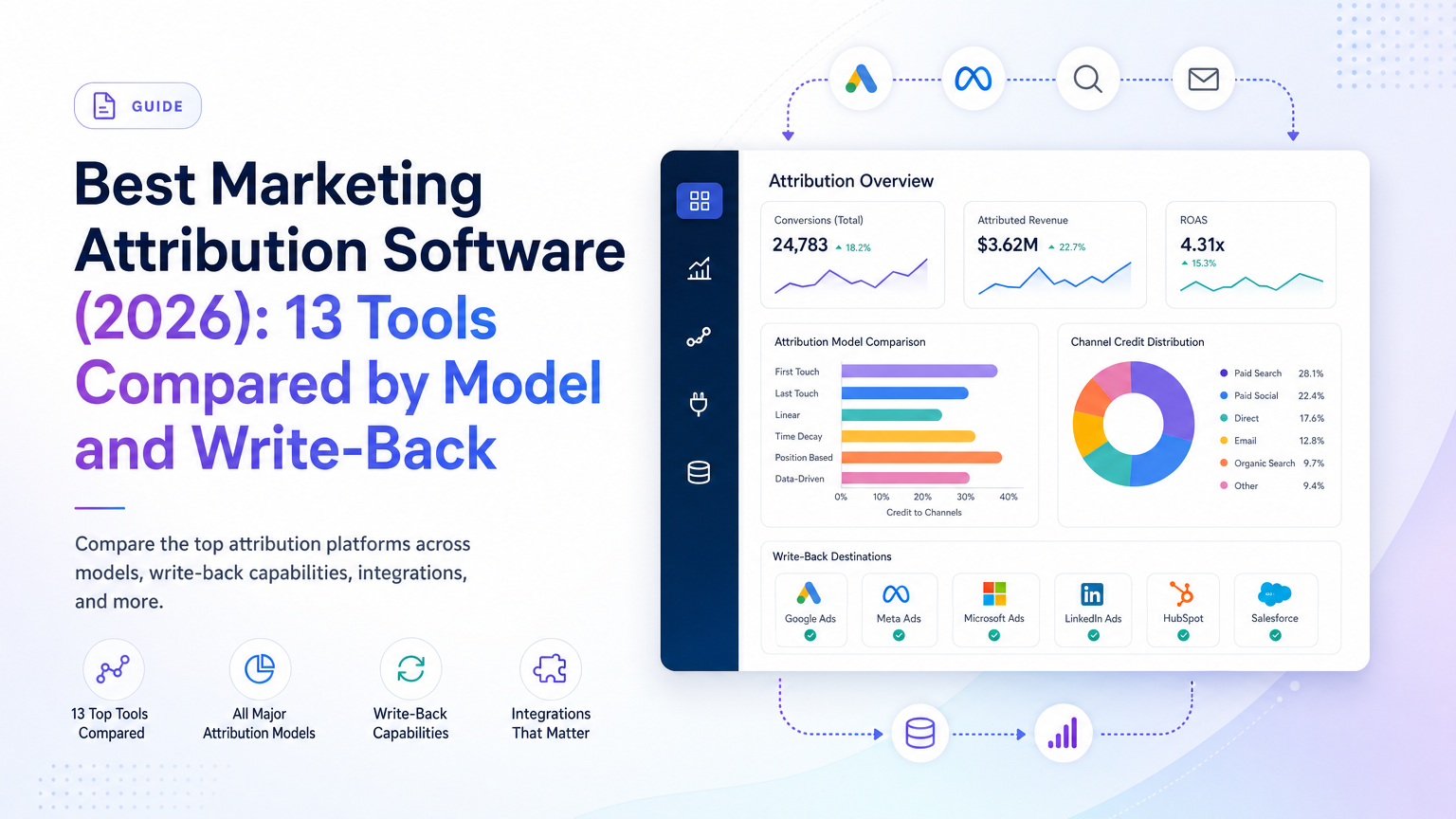
Most "best marketing attribution software" lists are written by an attribution vendor, and that vendor ranks first. This one isn't. Soku doesn't sell attribution (more on what it does do at the end). On 2026-10-20 we read the pricing and product pages of 13 attribution tools and recorded four things for each: which measurement models it actually offers (multi-touch attribution, media mix modelling, incrementality testing), whether it sends matched conversions back to Meta, Google and the other ad platforms, who it's built for, and whether the price is printed anywhere.
The headline result: only five of the 13 publish a number. Most of them run attribution, MMM and conversion write-back as separate products, and only a few vendors cover all three.
Last verified: 2026-10-20. Every price and capability below comes from the vendor's own website on that date, linked at the claim. Where a vendor shows no price, we say so instead of repeating a third-party estimate. This page helps you choose software. For the theory of how last click, data-driven, MTA, MMM and incrementality differ and how much conversion volume each one needs, read the pillar: multi-touch attribution models compared.
The short answer: which attribution software fits which business
| If you are… | Start your shortlist with | Why |
|---|---|---|
| A Shopify or DTC brand | Triple Whale, Northbeam, Wicked Reports | Built around orders, ROAS and new-customer revenue |
| A direct-response, info-product or call-funnel business | Hyros | Server-side tracking and sending conversions back to ad platforms, sold on a custom quote |
| B2B SaaS tracking pipeline and revenue from a CRM | Cometly, Dreamdata, HockeyStack | Account journeys, CRM stages, sends conversions back to LinkedIn and Google |
| A lead-gen business with calls and forms | Ruler Analytics | Call tracking, form and chat capture, MTA plus MMM, published prices |
| A big spender who needs a causal answer | Haus, Measured | Geo and holdout experiments, MMM calibrated on those experiments |
| A team with an analyst and no budget | Google Meridian, Meta Robyn | Free open-source MMM; you supply the data and the modelling time |
| A team with omnichannel spend and complex measurement needs | Rockerbox | MTA, MMM and managed incrementality on one data foundation |
How we compared them
We used one criterion per column, and every cell traces back to a vendor page.
- MTA: the vendor says it assigns credit across observed touchpoints at the user, order or account level.
- MMM: the vendor offers media mix modelling, either built in or as an add-on.
- Incrementality: the vendor runs or supports holdout or geo experiments that compare exposed and unexposed groups.
- Write-back: the vendor documents sending conversions to ad platforms (Conversions API, offline or enhanced conversions), as opposed to just reading data from them.
- Published price: a dollar figure on the vendor's own pricing page on 2026-10-20. "Quote" means the page exists but shows no number.
We left out vendors whose capabilities or prices we couldn't read from their own pages that day. The exclusions are listed at the end.
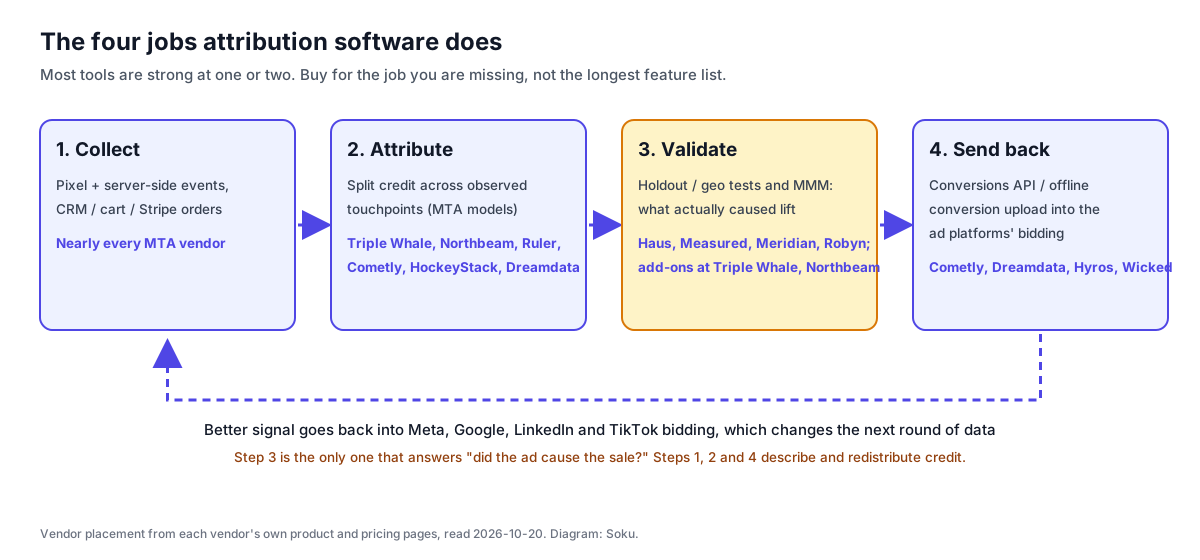
The diagram is the most useful way to read the rest of this page. Attribution software does four different jobs, and tools that look like competitors are often doing different ones. A B2B team comparing Cometly with Haus isn't comparing like with like. Cometly collects, attributes and sends conversions back. Haus runs experiments that tell you whether the ads caused anything at all. Many mature teams end up with one tool from each group.
The comparison matrix: models and write-back, from vendor docs
| Tool | Built for | MTA | MMM | Incrementality | Write-back to ad platforms | Published price (2026-10-20) |
|---|---|---|---|---|---|---|
| Triple Whale | Ecommerce, Shopify DTC | Yes (Foundation and up); first and last click on Free | Enterprise (Compass) | Enterprise (holdouts, geo-lift) | Yes: Sonar Optimize sends to Meta, Google, TikTok, Reddit, X, AppLovin, ChatGPT Ads, Realize | Free plan; paid tiers priced by GMV, no price shown on screen |
| Northbeam | Ecommerce, multi-channel | Yes, including view-through (C+DV) | Optional on Enterprise (MMM+) | Optional on Professional and Enterprise | Yes: Apex, for Meta and AppLovin | $1,500 Starter card; $3,500/mo Professional; Growth and Enterprise custom |
| Rockerbox | Omnichannel brands | Yes | Yes | Yes (managed testing) | Not documented on the pages we read | Quote |
| Hyros | Direct response, info products, calls, SaaS | Yes (server-side tracking) | Not offered | Not offered | Yes: sends sales to Meta and Google | Quote (custom, set on a call) |
| Wicked Reports | Ecommerce and subscriptions | Yes, lifetime lookback | Not offered | Not offered | Yes: Meta CAPI (Advanced Signal), Google conversions API | $499 / $699 / $999 per month under $2.5M revenue; Enterprise from $4,999 |
| Cometly | B2B SaaS | Yes | Not offered | Not offered | Yes: Meta, Google, LinkedIn, TikTok, Microsoft, Reddit | Quote (priced by pageviews) |
| Ruler Analytics | Lead gen, calls, B2B | Yes: first, last, linear, time decay, position, data-driven | Yes | Not offered | Yes: revenue passed back to Google Ads | From $400/mo ($360 annual) |
| HockeyStack | B2B revenue teams | Yes | Not offered | Lift reports (exposed vs unexposed accounts) | Yes: pushes conversion data to ad platforms | Quote |
| Dreamdata | B2B, account-based | Yes (AI and custom models) | Not offered | Not offered | Yes: LinkedIn CAPI, Google Enhanced Conversions, Meta, Microsoft | Free plan; attribution plan custom |
| Haus | Brands that want causal answers | Causal Attribution product | Causal MMM (Plus, Enterprise) | Yes: core product, geo experiments | Not offered | Quote |
| Measured | Enterprise brands | Not the focus | Yes, test-calibrated | Yes: core product | Not offered | Not published on the pages we could read |
| Google Meridian | Analysts, data teams | No | Yes (open source) | Geo experiments via Meridian GeoX | No | Free (open source) |
| Meta Robyn | Analysts, data teams | No | Yes (open source) | Calibrates to geo or lift results | No | Free (open source) |
Three patterns stand out.
MTA and causality are mostly sold separately. Only Rockerbox offers all three model families as standard. Triple Whale and Northbeam get there through Enterprise tiers or add-ons. Every B2B tool on the list is MTA-first. HockeyStack's lift reports compare accounts that were exposed with accounts that weren't, which is useful, but it isn't the same as a randomized holdout.
Write-back is now table stakes for MTA vendors. Seven of the nine MTA-style tools document sending conversions back to at least one ad platform. That changes what you're buying. A tool that only reports is a dashboard. A tool that writes back also changes how Meta and Google bid, so check which platforms it writes to before anything else.
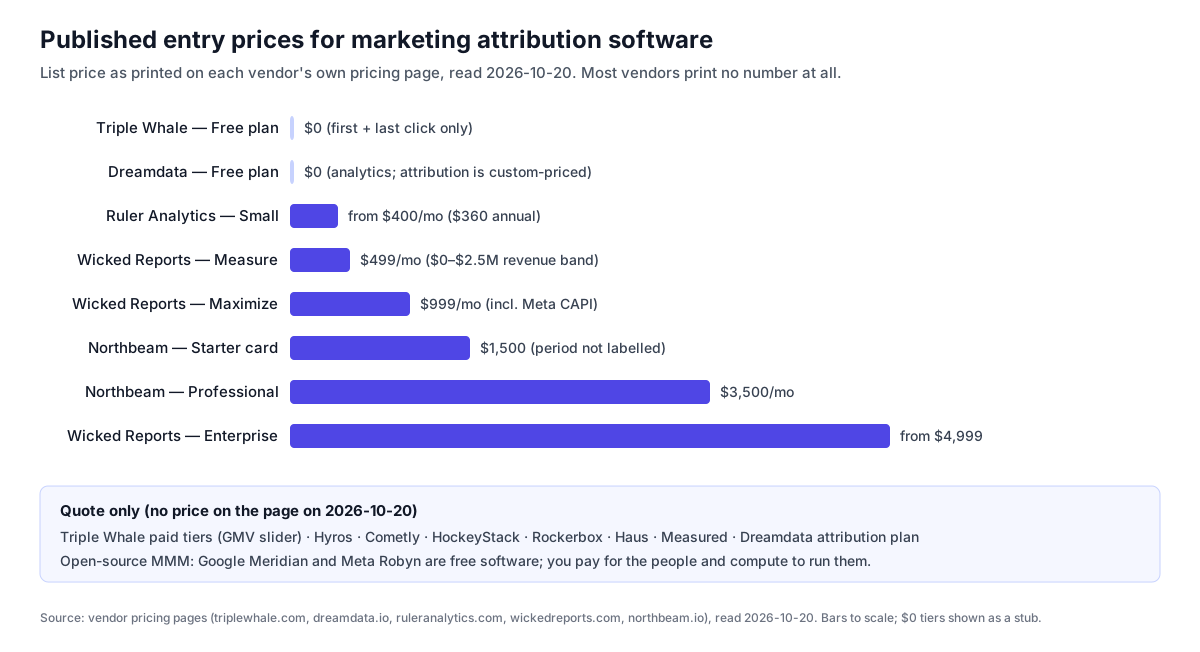
Price transparency is rare. The chart shows every number we could find. Everything else is a sales call.
Ecommerce and DTC attribution software
Triple Whale
Triple Whale is the default shortlist entry for Shopify brands. Its Free plan includes the Triple Pixel and first-click and last-click attribution. Foundation adds multi-touch attribution, dashboards, a SQL editor and Moby AI, and says it will "push high-intent signals back to your key platforms." Automate adds Moby actions on paid media and creative generation. Enterprise adds holdouts, geo-lift tests and marketing mix modelling under the Compass name. Write-back runs through Sonar Optimize, which sends enriched events to AppLovin, ChatGPT Ads, Google, Meta, Realize, Reddit, TikTok and X.
Price: paid tiers are priced by annual GMV, and on 2026-10-20 the pricing page rendered no dollar figures on screen. Its FAQ says Foundation, Automate and Enterprise are 12-month subscriptions, billed monthly or annually. Our Northbeam vs Triple Whale comparison and Triple Whale pricing breakdown carry the GMV-banded ladder from the page's own code. Best for: Shopify brands that want attribution, dashboards and an AI analyst in one place. Watch out for: MMM and incrementality are Enterprise-only, and the paid tiers are annual commitments.
Northbeam
Northbeam sells first-party multi-touch attribution with clicks plus deterministic views (C+DV), plus optional MMM+ and incrementality on higher tiers. Its write-back product, Apex, "connects your first-party data to multiple ad algorithms" and is listed as available for Meta and AppLovin.
Price: the Starter card (for brands spending under $1.5M a year on ads) shows $1,500 without a clear billing period. Professional shows $3,500 per month. Growth and Enterprise are custom. Both priced cards also say "Contact us for a quote," so treat the numbers as list prices, not offers. Best for: ecommerce teams with meaningful multi-channel spend who want view-through attribution. Watch out for: MMM and incrementality cost extra. For the two side by side, including how their view-through models split the same order, see the comparison linked above.
Rockerbox
Rockerbox describes itself as a data foundation (collect, track, export) with three analysis products on top: multi-touch attribution, marketing mix modelling and incrementality testing, which it runs as a fully managed service. Its integrations page lists more than 100 sources, including OTT/TV, direct mail and affiliate. Its plans page shows no prices, and its /pricing URL returned a 404 on 2026-10-20. We found no documented conversion write-back on the pages we read.
Best for: brands with spend across offline and online channels that want MTA, MMM and testing from one vendor. Watch out for: you can't estimate cost before a sales call.
Wicked Reports
Wicked Reports is the most transparent ecommerce option on this list. For brands with $0 to $2.5M in annual revenue, Measure costs $499 a month, Scale $699 and Maximize $999. Enterprise starts at $4,999. Pricing is banded by your last 12 months of gross revenue. Maximize includes Advanced Signal (Meta CAPI) and 5 Forces AI, each $199 a month as an add-on on lower tiers. Wicked also sends lead or sales data to Google Ads through what it describes as three Google conversion API integrations.
Best for: ecommerce and subscription brands that care about lifetime value and want to know the cost upfront. Watch out for: no MMM or incrementality product.
Hyros
Hyros is server-side ad tracking built for direct-response funnels: courses, coaching, booked calls, SaaS trials and ecommerce. Its homepage shows sales being sent back to Meta and Google, labelled "receiving conversions." The pricing page now says there is one plan, priced custom on a setup call according to the revenue Hyros tracks, with a "your ads grow or you do not pay" guarantee. Older figures, including a "$230 a month" number on Hyros's own May 2026 blog, no longer appear on the pricing page, so we don't repeat them as current. More detail is in our Hyros alternative page.
Best for: high-ticket and call-based funnels where a single customer can be worth thousands. Watch out for: no MMM or incrementality, and no price until the call.
B2B and lead-gen attribution software
Cometly
Cometly now positions itself squarely on B2B SaaS: a pixel, server-side tracking, multi-touch attribution, account journeys and an AI agent. Its Conversion API sends server-side conversions to Meta, Google, LinkedIn, TikTok, Microsoft and Reddit. The product page adds Taboola and the pricing FAQ adds Snapchat, so confirm the exact list for your channels. There are two plans, Core and Enterprise. Both are priced by monthly pageviews and quoted on a call. Annual billing saves 20%, and there's no free trial. CRM and warehouse sync, the MCP server and the API are Enterprise-only.
Best for: SaaS teams that want ads optimized on paying customers rather than trial signups. Watch out for: warehouse export requires Enterprise.
Ruler Analytics
Ruler Analytics is the most complete published offer for lead-gen businesses. It captures forms, phone calls (dynamic call tracking), live chat and offline events, and ties them to CRM revenue. MTA models include first click, last click, time decay, linear, position-based and data-driven. MMM covers modelled ROAS, diminishing returns and a budget scenario planner. On its Google Ads integration page, Ruler says it "passes all of the revenue data back into Google Ads" at the point of sale.
Price: Small (up to 10k monthly visits) from $400 a month, or $360 on annual billing. Medium from $668 ($601 annual), Large from $1,326 ($1,193), Advanced from $2,000 ($1,800). Ruler calls these "indicative pricing" that scales with traffic, product and integrations. Best for: service businesses whose leads arrive by phone and form. Watch out for: write-back is documented most clearly for Google Ads; ask about the other platforms you use.
HockeyStack
HockeyStack is a B2B revenue data platform with multi-touch attribution, configurable models without SQL, and lift reports that "compare exposed and unexposed accounts." It says it syncs data both ways with your CRM, ad platforms and warehouse, and pushes conversion and attribution data back to your tools. Its pricing page shows customer stories but no plans or prices.
Best for: enterprise B2B marketing ops teams reporting pipeline influence to leadership. Watch out for: lift reports are observational comparisons, not randomized experiments.
Dreamdata
Dreamdata has a real Free plan at $0 a month: B2B web analytics, company identification, an audience builder and an ad spend report, with 2 months of history and 5 seats. Its attribution features (AI and custom attribution models, revenue analytics) sit in a custom-priced plan, with Activation as an add-on. Dreamdata's own Audience Hub 2.0 announcement lists offline conversion syncs to LinkedIn's Conversions API, Google Enhanced Conversions, Meta Conversions and Microsoft Enhanced Conversions. Its Meta Conversions documentation notes that Meta only accepts events up to 7 days old from when the sync is created.
Best for: account-based B2B teams who run LinkedIn and want pipeline stages sent back as conversions. Watch out for: the free plan doesn't include attribution.
Incrementality and MMM
Haus
Haus is an incrementality company first. Basics runs self-serve geo experiments on major platforms (Meta, Google, TikTok) in the US and measures orders and revenue through Shopify and Amazon. Core adds custom KPIs, international tests and warehouse support. Plus adds non-geo channels (influencer, podcast, TV) and Causal MMM built on your experiments. Enterprise adds portfolio-level testing and a dedicated data scientist. It also sells a Causal Attribution product. No prices are shown, and there's no conversion write-back, because that isn't what it's for.
Best for: brands spending enough that a wrong budget call costs more than the tool. Watch out for: experiments need enough geographic scale and time to read; this isn't a daily dashboard.
Measured
Measured describes itself as an "AI-powered marketing effectiveness platform" for enterprise brands that "combines causal experiments with media mix modeling," with MMM calibrated on those tests. On 2026-10-20 its pricing page returned a bot check to our reader, and its homepage shows no price, so we list it as not published.
Best for: enterprise portfolios that need incrementality and MMM managed together. Watch out for: built for enterprise budgets and processes.
Google Meridian (open source)
Meridian is "an open-source MMM built by Google." The newer Meridian GeoX lets you run geo experiments and turn the results into priors that calibrate the model. It also models reach and frequency for video and includes scenario planning. The software is free. The cost is the analyst time, clean weekly spend and outcome data, and the discipline to recalibrate. If MMM is new to you, start with our marketing mix modelling guide.
Meta Robyn (open source)
Robyn is the open-source MMM from Meta's marketing science team. It uses ridge regression, automated hyperparameter search with Nevergrad, and Prophet for trend and seasonality. It calibrates against "ground-truth methodologies (Geo-based, Facebook lift, MTA, etc.)" and includes a budget allocator. Robyn needs no PII or cookies. Like Meridian, it's free to run but not free to operate.

Photo: Headway on Unsplash.
What "write-back" actually buys you
Write-back is where attribution software has changed most since 2023, and it's the column most vendor listicles skip. Here is what it means in practice.
When a tool writes back, it sends the conversions it has matched to the ad platform's own conversion endpoint: Meta's Conversions API, Google Ads' offline or enhanced conversions, LinkedIn's Conversions API. The platform then counts and bids on conversions its own pixel missed, such as a sale on another device, a deal closed in the CRM three weeks later, or a phone order. Cometly says it is built to lift Meta event match quality. Dreamdata and Cometly both pitch sending only paying customers so Meta and LinkedIn optimize for revenue instead of signups.
Three things to check on any demo:
- Which platforms, exactly. "Ad platforms" on a feature page can mean one platform. Northbeam's Apex lists Meta and AppLovin; Ruler's page documents Google Ads; Triple Whale's Sonar Optimize lists eight destinations. Get the list in writing.
- Deduplication with your existing pixel. If the browser pixel and the server event both fire for one purchase, the platform needs a shared event ID to count it once. Ask how the vendor handles that.
- What the platform does with late events. Platforms limit how old an event can be. Dreamdata's docs say Meta accepts events up to 7 days old from when the sync is created. A B2B deal that closes in week six may never reach Meta as a conversion.
Write-back improves the signal the platforms optimize on. It doesn't make the platform's reported ROAS any more trustworthy, because the platform is now counting conversions your tool handed it. To find out what the ads caused, you still need step 3 in the diagram above. Our incrementality testing guide covers how to run that cheaply.
How to choose, in five questions
- Ecommerce or pipeline? Order-based tools (Triple Whale, Northbeam, Wicked Reports) model carts and new-customer revenue. Pipeline tools (Cometly, Dreamdata, HockeyStack, Ruler) model leads, accounts and CRM stages. Using one built for the other means fighting its data model.
- How many conversions a month? Under a few hundred per conversion action, no vendor's MTA model has much to work with. GA4 plus platform reporting plus one incrementality test will tell you more. The volume thresholds are in the pillar on attribution models.
- Do you need a causal answer, or a daily one? MTA tells you where to shift budget tomorrow. Incrementality and MMM tell you whether a channel deserves budget this quarter. Most teams under about $1M a year in spend need the first; teams spending far more need both.
- Which ad platforms must receive conversions? If LinkedIn matters, check LinkedIn CAPI support (Cometly, Dreamdata). If AppLovin matters, Triple Whale and Northbeam both list it.
- Can you see the price before the call? Five of the 13 publish one. If budget certainty matters, start with Ruler, Wicked Reports, Northbeam or the free tiers and use their numbers as anchors when other vendors quote.
Before you sign anything, make sure your UTMs are consistent. Every tool on this list joins ad clicks to sessions through them. Our UTM naming conventions for paid media post has a scheme that survives a cross-channel audit, and the cross-channel attribution setup guide covers the build order.
Where Soku fits (and where it doesn't)
Soku isn't attribution software, and none of the tools above is a direct substitute for it, or it for them. Soku is an AI agent that builds and runs ad campaigns. On measurement, here is what the product does today:
- Reads platform-reported results from connected ad accounts on Meta, Google Ads, TikTok, LinkedIn, Reddit, X and ChatGPT Ads: spend, clicks, conversions and conversion value.
- Reads GA4 for sessions, traffic sources, key events and revenue.
- Second Opinion. For each platform, it shows the platform's own claimed results next to what GA4 independently credits to that platform and campaign, matched by campaign ID and never by name. It flags gaps such as missing campaign IDs or paid traffic from a platform you haven't connected. It never adds the two sides together and never treats GA4 as absolute truth. It doesn't deduplicate orders, stitch identities across devices, build MTA models or measure incrementality.
- Conversions, with a human in the loop. It can check whether a brand's Google Ads conversion actions and Meta pixels are set up to receive offline conversions, read-only. It can send a single Meta Conversions API event, but only after review. It doesn't run an ongoing conversion write-back pipeline the way Cometly or Dreamdata do.
So the honest pairing is: a tool from this list establishes what's true, and Soku acts on it by pausing what doesn't pay, building the next creative test and moving budget toward your CAC or ROAS target, with every change behind an approval card. If you use Triple Whale, our Triple Whale alternative page covers where the two overlap and where they don't.
Where to go next
- Model theory and volume thresholds: Multi-touch attribution models compared. This is the pillar for this cluster.
- Setting it up across channels: Cross-channel marketing attribution: a practical setup.
- The causal layer: Incrementality testing and marketing mix modelling.
Vendors we left out, and why
- AdBeacon publishes "starts at $299/mo, varies on monthly tracked revenue" and lists a Google Meridian MMM integration, but we couldn't confirm its conversion write-back from its own pages on 2026-10-20, so it isn't in the matrix.
- Measured is included, but its price cell says "not published on the pages we could read" because its pricing page returned a bot check that day.
- We didn't include platform-native tools (Meta's attribution settings, Google Ads data-driven attribution) or GA4 as separate entries. They're covered in the pillar.
Sources
All pages read on 2026-10-20: Triple Whale pricing, Triple Whale Sonar Optimize, Northbeam pricing, Northbeam Apex, Rockerbox plans, Hyros pricing, Hyros homepage, Wicked Reports pricing, Wicked Reports Google conversions API, Cometly pricing, Cometly Conversion API, Ruler Analytics pricing, Ruler Google Ads integration, HockeyStack, HockeyStack pricing, Dreamdata pricing, Dreamdata Audience Hub 2.0, Dreamdata Meta Conversions docs, Haus pricing, Haus, Measured, Google Meridian, Meta Robyn, AdBeacon pricing.